


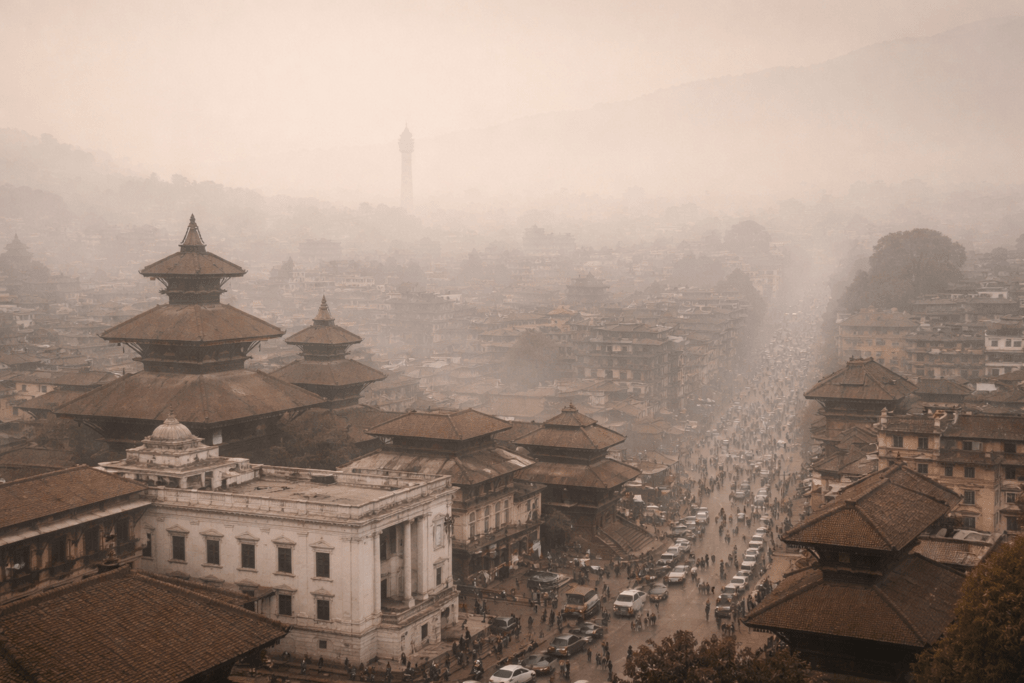

Kathmandu Valley continued to record unhealthy air quality for the second consecutive day, with pollution levels remaining above safe limits, according to real-time monitoring data on Thursday.
As of Thursday morning, the Air Quality Index (AQI) in Kathmandu stood at around 116 on the US AQI scale, placing the city in the category of “Unhealthy for Sensitive Groups.” The level indicates increased health risks for children, the elderly, and people with respiratory or heart conditions .
Advertisement



Particulate Matter Far Above WHO Limits
Data from air quality monitoring platforms show that PM2.5 concentration in Kathmandu reached approximately 42 micrograms per cubic metre (µg/m³). This is more than eight times higher than the World Health Organization’s recommended annual average limit of 5 µg/m³ .
Similarly, PM10 levels were recorded at around 77 µg/m³, contributing to visible haze across the valley and increasing risks of eye irritation, breathing discomfort, and reduced lung function.
Pollution Widespread Across the Valley
Air pollution remained consistently high across multiple monitoring stations in the Kathmandu Valley. Areas including Kharipati, Jhaukhel, Sallaghari, and the AHW Office area recorded AQI values ranging from 120 to 134, indicating that poor air quality was not confined to a single location but affected the wider urban area .

Seasonal Factors Behind Poor Air
Environmental experts attribute the sustained pollution levels to winter temperature inversion, vehicular emissions, road dust, and open burning of waste and biomass. During winter, stagnant air traps pollutants close to the ground, preventing their dispersion and worsening air quality across the valley.
Kathmandu has frequently appeared among the world’s most polluted cities during winter months, with AQI levels in past seasons occasionally crossing into the “very unhealthy” and “hazardous” categories .
Health Advisory Issued
Health officials recommend that children, elderly people, pregnant women, and individuals with asthma or heart disease limit outdoor activities until air quality improves. Residents are also advised to use face masks, keep windows closed during peak pollution hours, and avoid unnecessary outdoor exertion.
Authorities have urged the public to stay updated with official air quality bulletins as pollution levels may fluctuate depending on weather conditions.