

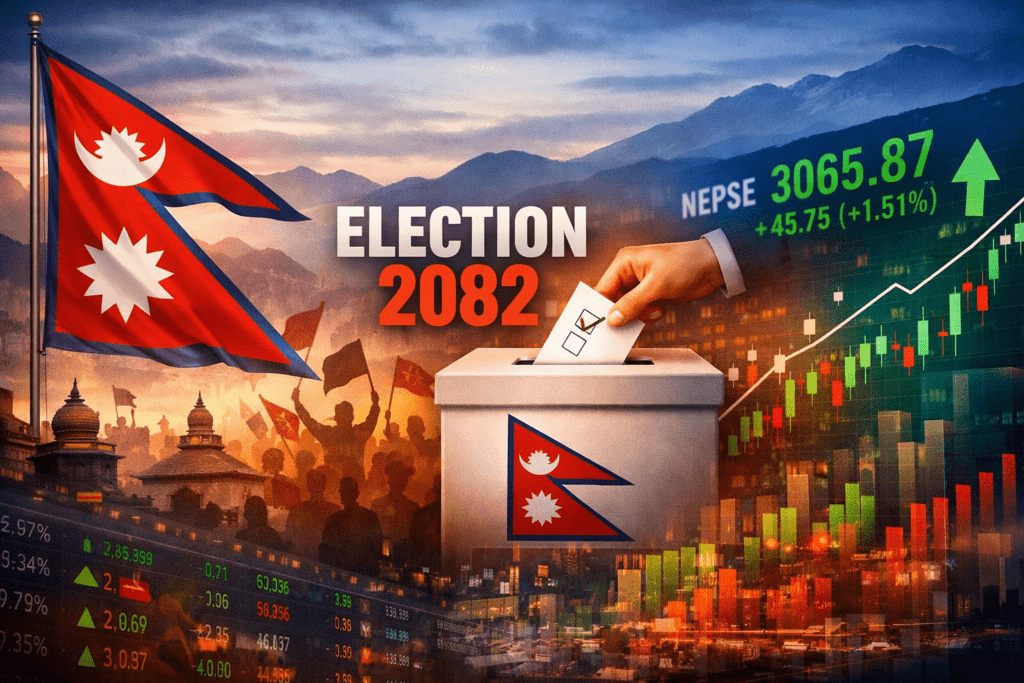

The upcoming general election in Nepal in 2082 has drawn significant attention from investors and market participants, as political transitions in the country have historically influenced stock market behavior. The Nepal Stock Exchange (NEPSE), like many emerging markets, is particularly sensitive to political uncertainty because government stability directly affects policy continuity, capital expenditure, regulatory reforms, and investor confidence. As elections approach, market participants tend to adopt a cautious stance, which often reflects in reduced trading volumes and heightened price fluctuations.
Advertisement



Statistical analysis of past election cycles in Nepal indicates a recurring pattern of increased volatility in the pre-election phase. Studies based on NEPSE index movements during previous elections show that uncertainty regarding coalition formation, leadership changes, and economic policy direction often leads to short-term market corrections or sideways movement. This behavior aligns with broader empirical research from emerging markets, where investors react more strongly to political risk due to limited policy predictability and higher dependence on government-led economic initiatives.
However, historical data also suggests that once election results are declared and a stable government is formed, the market gradually adjusts and often shows signs of recovery. Post-election periods in Nepal have frequently been associated with improved investor sentiment, especially when the new government signals commitments to infrastructure development, financial sector reform, and private-sector growth. Statistical trends imply that the resolution of uncertainty plays a more important role than the specific political outcome itself.

In conclusion, the 2082 election in Nepal is likely to influence the stock market primarily through short-term volatility driven by political uncertainty rather than long-term structural changes. While temporary fluctuations in the NEPSE index are expected around the election period, statistical evidence from past elections suggests that market performance over time will continue to depend more on economic fundamentals, policy execution, and overall political stability than on the election event alone.