


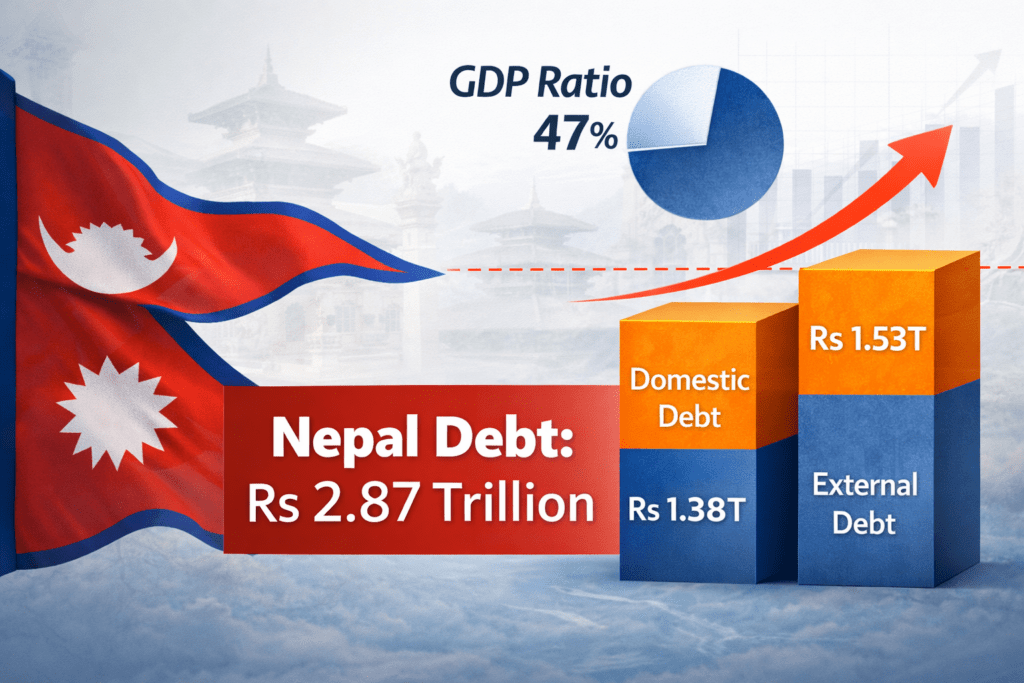

Nepal’s total public debt has increased sharply in the first eight months of the current fiscal year. According to the Public Debt Management Office, the country’s debt has now reached Rs 2,878.29 billion by mid-March.
At the start of the fiscal year 2082/83 (mid-July), the total debt stood at Rs 2,674.04 billion. This means the government has added over Rs 204 billion in a short period.
Advertisement


Total Debt Breakdown
Nepal’s public debt includes both domestic and external borrowing.
- Domestic Debt: Rs 1,348.11 billion
- External Debt: Rs 1,530.18 billion
Key Insight:
- External debt makes up 53.16% of total debt
- Domestic debt accounts for 46.84%
This shows that Nepal currently depends more on foreign borrowing than internal sources.
Debt Compared to GDP
The total public debt now stands at 47.13% of Nepal’s Gross Domestic Product (GDP).
This ratio is important because it shows how large the country’s debt is compared to its economy. A rising ratio can increase financial pressure on the government.
Government Borrowing Target
For the current fiscal year, the government aims to raise Rs 559 billion in public debt.
Progress So Far:
- Total raised: Rs 295.19 billion
- Achievement: 50.44% of the annual target
Domestic vs External Borrowing Performance
The government has performed differently in domestic and external borrowing.
Domestic Borrowing:
- Target: Rs 362 billion
- Raised: Rs 243.66 billion
- Achievement: 67.31%
External Borrowing:
- Target: Rs 233.66 billion
- Raised: Rs 56.89 billion
- Achievement: 24.31%
This shows that domestic borrowing is progressing well, while external borrowing remains slower.
Debt Repayment Status
The government has also allocated funds to repay debt during this fiscal year.
- Total allocation: Rs 411 billion
- Paid so far: Rs 242.26 billion
- Progress: 58.94%
This includes both principal repayment and interest payments.
Debt Servicing Cost
By mid-February, Nepal’s debt servicing cost stood at 3.97% of GDP.
This figure reflects how much of the country’s economy is used to pay interest and repay loans.

Conclusion
Nepal’s rising public debt highlights increasing financial pressure on the government. While domestic borrowing remains strong, external borrowing is slower than expected.
Managing debt levels, improving revenue, and ensuring effective use of borrowed funds will be key for maintaining economic stability in the coming years.